IThe Little Board
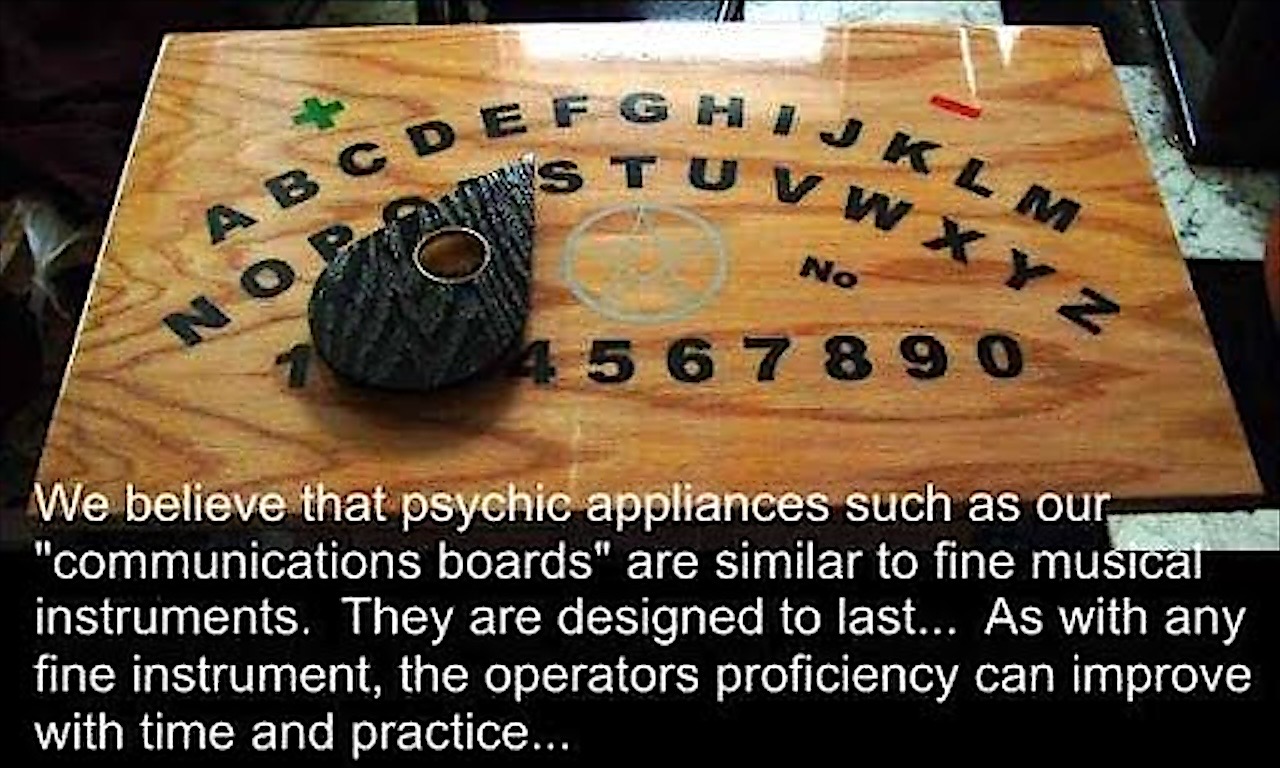
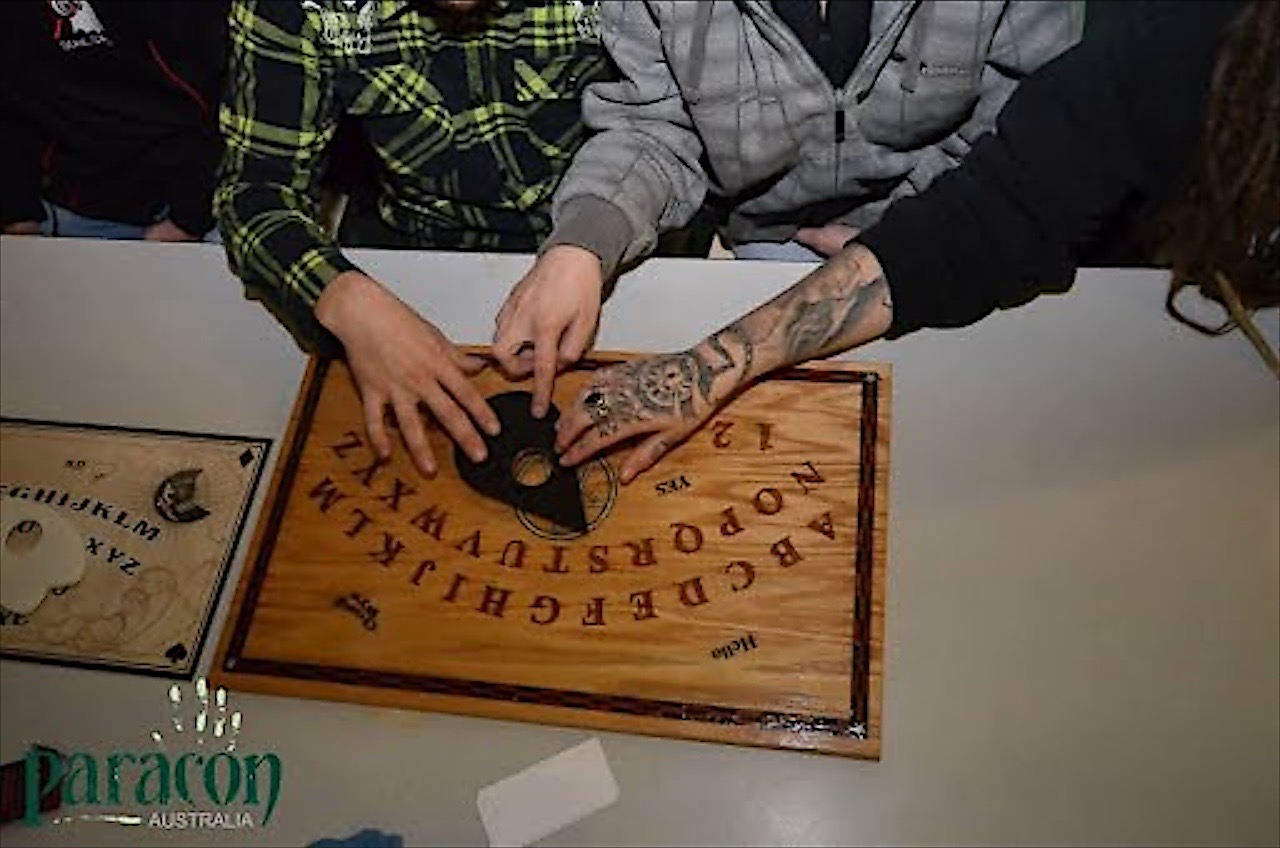
Planchette is French for a little board, and that is all it is: a small flat piece of wood on castors or feet, light enough to move under the weight of resting fingertips, with a pencil through it or a window in it. Two people, or one, lay their hands on it over a sheet of paper or a lettered board, and wait. It moves. With a pencil, it writes: loops first, then letters, then, for some sitters and on some nights, sentences. With a window, it points: to a letter, a number, a Yes, a No. The first is the automatic-writing planchette, and it is the older, the stranger, and the one I have made my life’s work. The second is the pointer, the planchette of the talking board and the Ouija, and it is the same instrument with the pencil taken out.
Why it moves is the question that made the board famous in 1853 and has kept it in print since. The answer that satisfies physiology is Chevreul’s: a hand at rest is never at rest, and a light board on smooth wheels is a machine for turning tremor and expectation into visible motion, without the mover knowing that he moves. The answer that satisfies the spiritualist is that something else is writing. I sell to both, and I have sat with both, and I will say only what I know: a heavy, badly balanced board on bad castors writes nothing for anybody, and a properly made one writes for nearly everyone. Whatever the source, the instrument decides whether it can be heard.
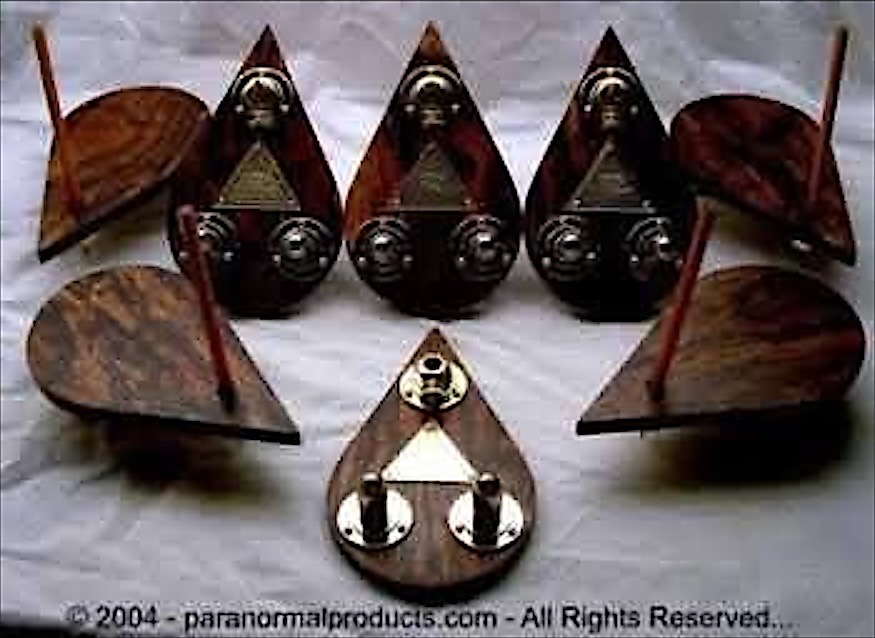
What follows is the longest account of the planchette I know of. It goes back further than 1853, because the planchette did not come from nowhere, and forward past 1890, because the Ouija board is the planchette’s child and the church that used it is part of its story. In the middle is a section on the proportion the board is cut to, which is not decoration, and at the end are the instruments. If you only want the instruments, the contents bar will take you there. I would rather you read.
IIBefore Paper: Bones, Sand, and Ash
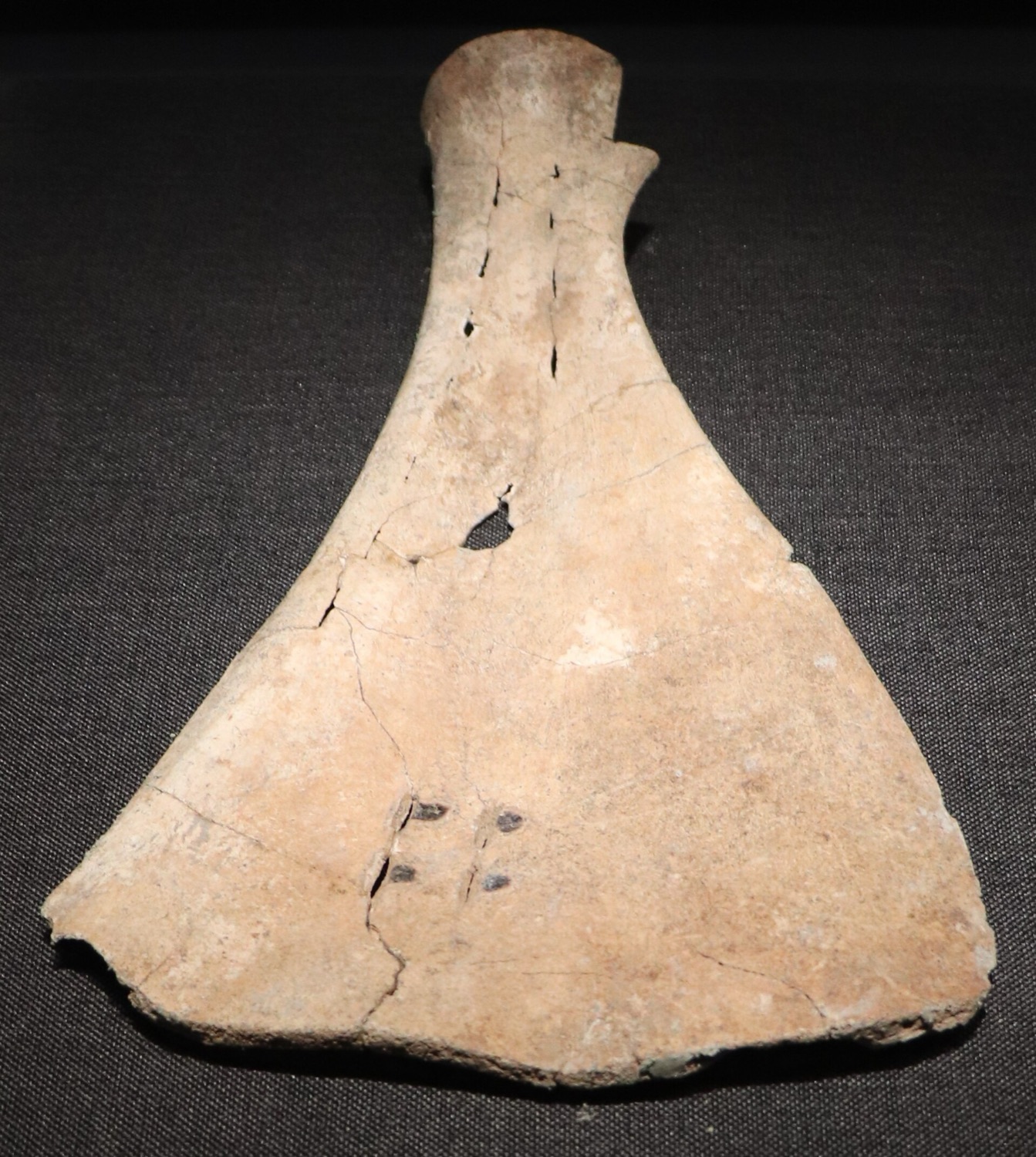
The oldest Chinese writing that exists is on the shoulder-blades of oxen and the bellies of turtles, and every word of it is a question to the dead. The kings of the Shang, around 1250 BC, had a bone drilled and heated until it cracked, read the crack as an answer, and had the question and the answer cut into the bone beside it: will the harvest come, will the queen’s child be a son, should the king attack the Qiang. Writing, in China, begins as divination, and divination begins as a surface that answers. Every board I make descends from that bone.
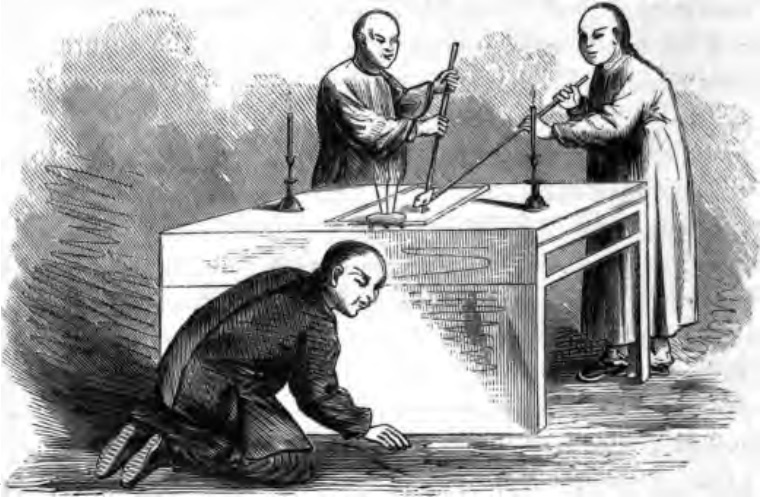
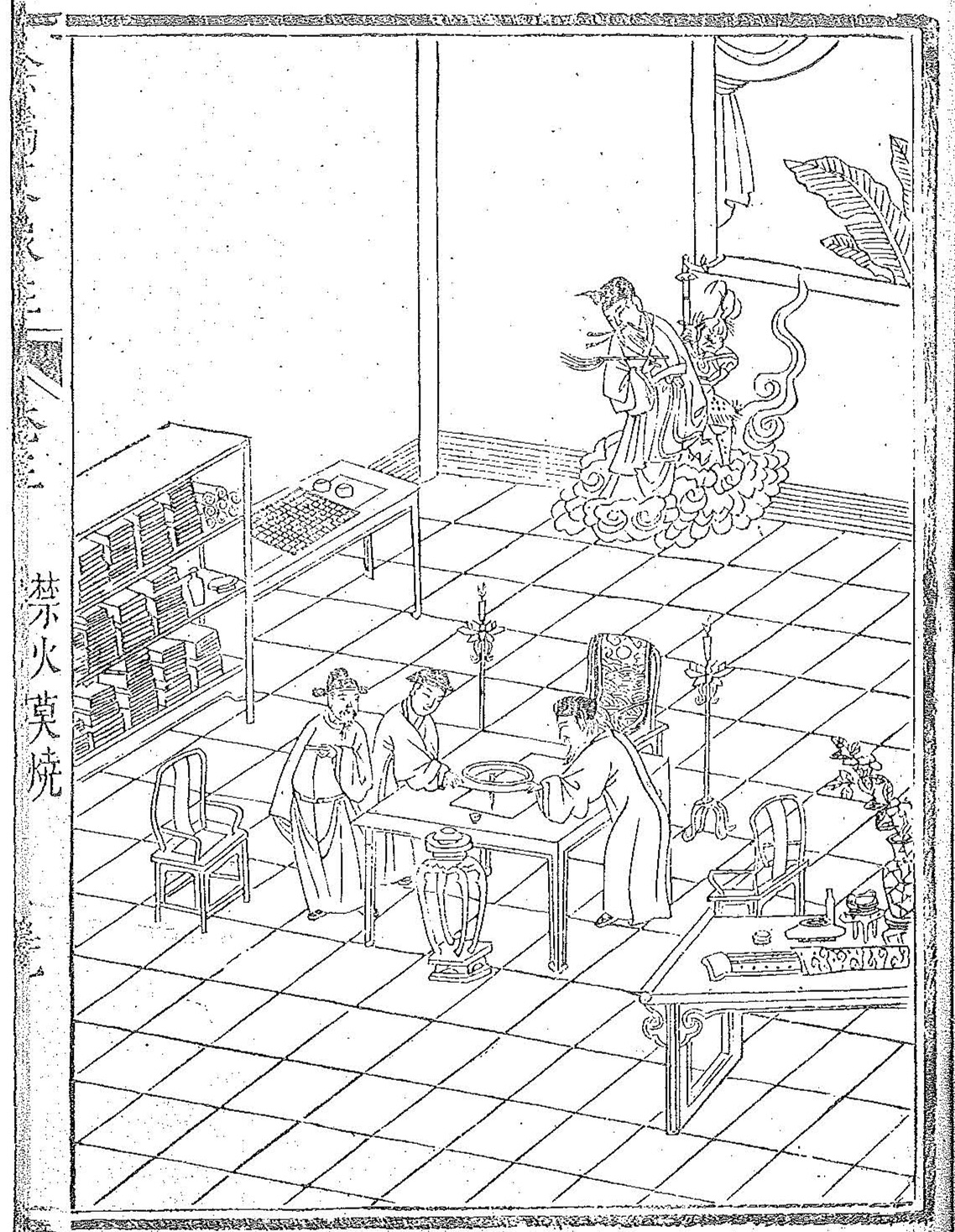
By the Song dynasty, a thousand years ago, the answering surface had become a tray of sand, and the crack had become a stylus. The practice is fuji, spirit-writing: a forked stick, or a stylus hung from a small frame, held at its ends by two people, its point resting in a shallow tray of fine sand or the ash from the incense burner. A deity or an immortal is invited; the stick moves; a third person reads the characters as they form and calls them out; a fourth writes them down and smooths the sand for the next. Shen Kuo describes it in 1088. By the Ming and Qing it was everywhere: scholars consulted it before examinations, families asked it where the lost jade had gone, and the charity halls of the nineteenth century published whole scriptures the stylus had written, by the volume. In Dream of the Red Chamber, the great novel of the 1750s, the nun Miaoyu is asked to work the planchette when a jade goes missing, and the scene needed no explanation for its readers.
It is worth pausing on what the Chinese instrument already was: a light stylus moved by two pairs of hands, writing in a medium that could be read and then erased. That is the automatic-writing planchette, complete, five hundred years before Paris. Whether the idea travelled west with the Jesuits or was reinvented is not known. What is known is that the human hand, given a light thing to hold and a surface that will take a mark, will write, and has done so on every continent that had a surface.
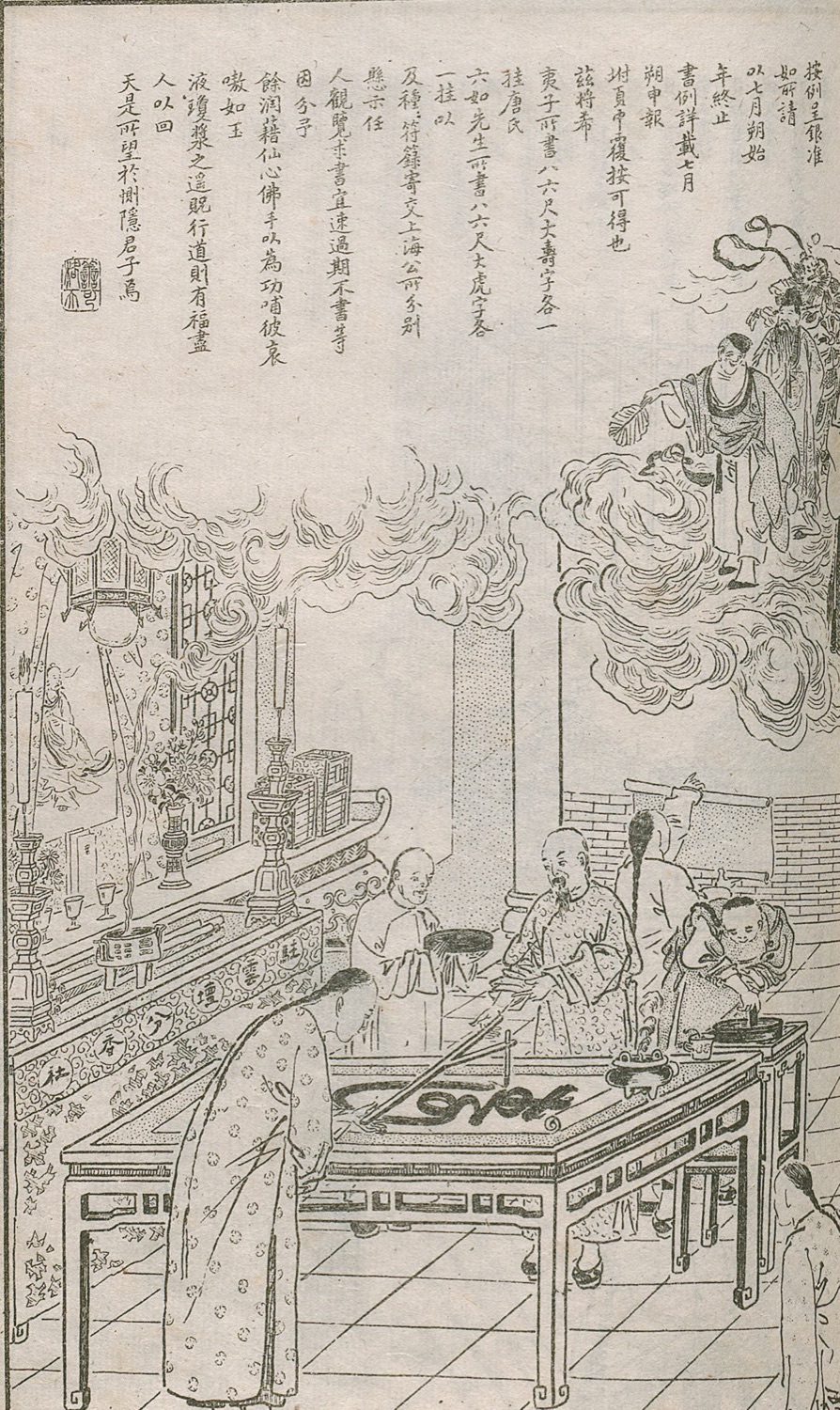
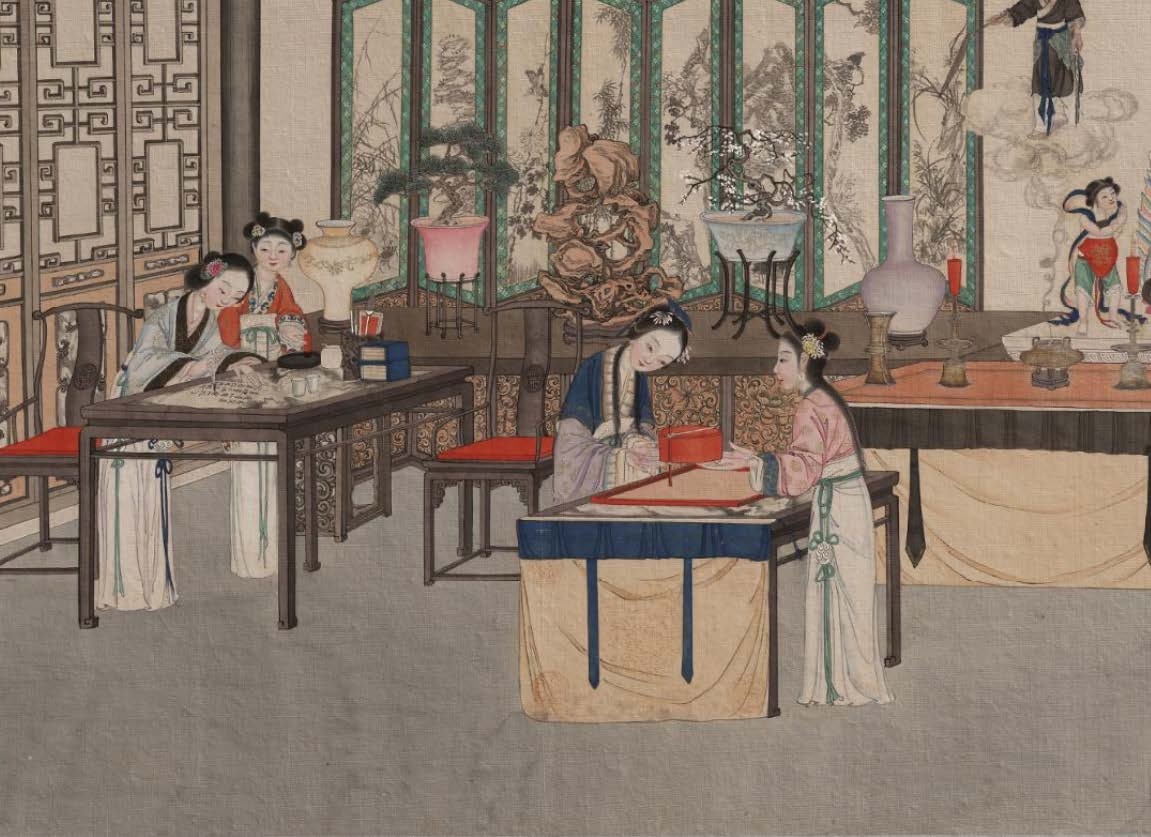
Behind the sand-tray lies something older and less documented, and I will say plainly that here I am guessing, as everyone is. Every people that has left a record cast lots: knucklebones in Greece and Rome, the astragali that became dice; arrows in Arabia; rods in the Yijing; sticks and stones and shells across Africa and the Americas. The principle is the same each time. Take an object, put it in the hand, and let something other than the will decide where it falls. I have heard it said that the first diviners balanced bones on the back of the hand and walked, and read the ground by where the bones fell, and it may be so; it would be a dowsing rod before there were rods. What the record supports is more modest and more interesting: that as soon as people could write, they built machines to let the writing come from somewhere else, and that the planchette is the latest of those machines, not the first.
IIIParis, 1853: the Basket with a Beak
The story told in the trade, and the one I was told when I began, is that the planchette was invented by French monks and forbidden by the Bishop of Paris as a means of speaking with the dead. I have gone looking for the monks and the edict, and I have not found them. What I have found is better, because it is true, and it is this.
In the spring of 1853 a craze reached Paris from America by way of Bremen: table-turning. A circle of sitters laid their hands on a small table, and the table tilted, rapped, and answered questions by counting. Within weeks half of Paris was doing it, and within months the more serious sitters had grown impatient with the alphabet counted out one rap at a time. Someone in a Paris circle, the name is lost, fixed a pencil to the rim of a small wicker basket, turned the basket upside-down on a sheet of paper, and had the sitters rest their fingers on it. The basket moved, the pencil wrote, and the corbeille-à-bec, the basket with a beak, was born. It was clumsy, and it was quickly replaced by a small board on two castors with the pencil through a hole at the front: the planchette. Allan Kardec, the Lyon schoolmaster who became French spiritism’s lawgiver, describes both instruments in his Livre des Médiums of 1861 as things every circle knew, and gives the planchette as the improvement.
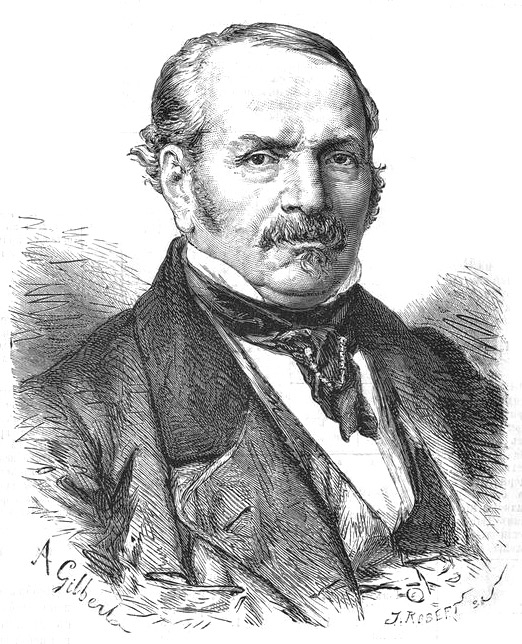
So: not monks, but the drawing-rooms of the Second Empire; not one inventor, but a season; and a basket before a board. The wicker basket is real. The bishop is real too, though not in Paris. The Church moved against the whole movement, not the instrument: in August 1856 the Holy Office in Rome warned the bishops of the world against the evocation of spirits under the cover of animal magnetism, and on 9 October 1861 the Bishop of Barcelona had three hundred of Kardec’s books, seized at the customs, burned in the public square, an event the spiritists called the auto-da-fé of Barcelona and never let the Church forget. Rome condemned spiritist practices again in 1898 and in 1917 forbade Catholics to attend a séance for any reason, and that prohibition stands in the Catechism today. There was never a need for an edict against the planchette. The whole practice was already forbidden, and the little board went on being sold in every stationer’s in Paris regardless.
Kardec is the man to read if you want to know how the planchette was used in its first decade. He is unromantic, orderly, and precise: the basket, the board, the two mediums, the questions to be asked and not asked, the signs of a good communication and of a frivolous spirit. He also records, without embarrassment, that the pencil at first draws only strokes and circles, and that it takes many sittings before it writes; that some sitters never get past the circles; and that the writing, when it comes, is in the hand of the medium and not of the dead. He believed in the spirits absolutely, and he described the instrument like an engineer. It is the right way to describe it.
IV1868: the American Season
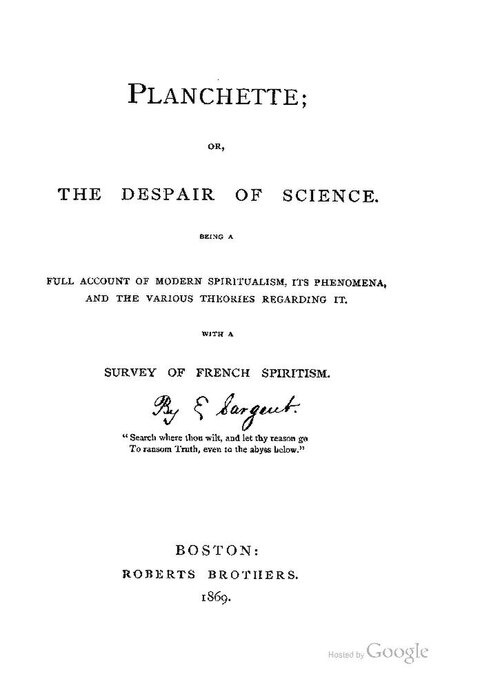
The planchette crossed the Atlantic slowly, and then all at once. It was known in American spiritualist circles in the 1850s, imported from Paris; it became a national event in the summer of 1868, when Kirby & Co. of 699 Broadway began advertising Kirby’s Planchette and G. W. Cottrell of Boston answered with the Boston Planchette, and the newspapers discovered that a toy on wheels would sell papers. By autumn it was in every bookshop and stationer’s, at prices from a dollar to five, in walnut, rosewood, and, from the first season, solid glass, so the sitters could watch the pencil write beneath their hands. The Scientific American explained it; the clergy denounced it; the humorists made hay; and Epes Sargent, a Boston editor of unimpeachable respectability, wrote a three-hundred-page book called Planchette; or, The Despair of Science, which sold through several printings to a public that wanted to be told what it had just bought.
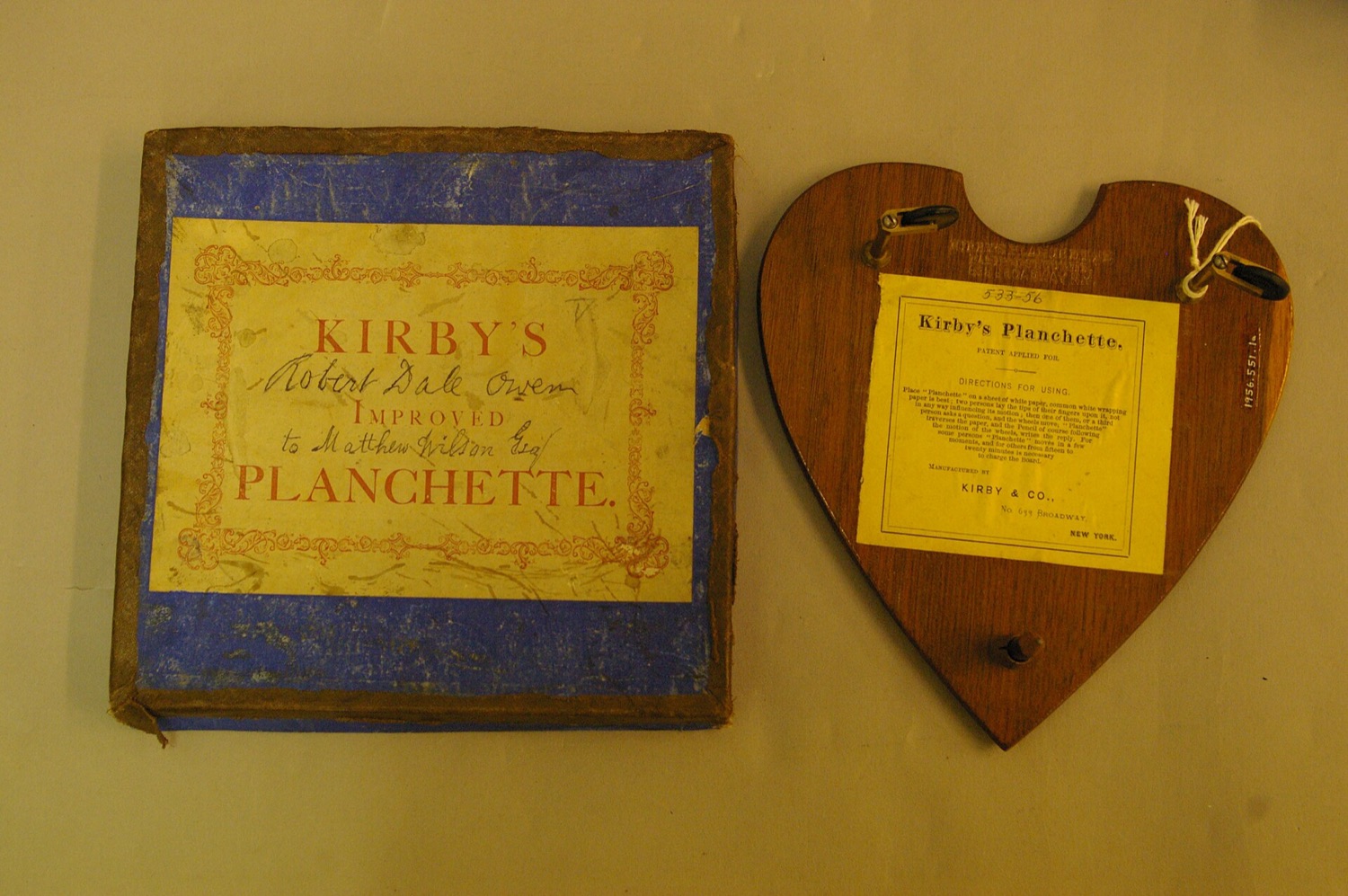
The American planchette of 1868 is a specific object, and the one below is the type: a heart-shaped board of thin walnut, seven or eight inches long, on two small castors of brass and rubber at the lobes, with the pencil pushed through a hole at the point, so that the board rides on three points and every tremor of the hands goes into the pencil. Kirby’s label gives the method in a sentence: paper on the table, two persons’ fingertips on the board, and the pencil writes the reply. It adds, honestly, that for some the board moves in a few moments and for others it takes fifteen or twenty minutes to charge. This one was given away by Robert Dale Owen, a congressman, a diplomat, and the most respectable spiritualist in America, whose Footfalls on the Boundary of Another World had made the movement safe for the drawing-room eight years before.
Look at it carefully, because it is the standard I am measured against and the one I have spent twenty-three years surpassing. The wood is thin and light, which is right; the castors are small and the rubber is gone, which is not; the pencil is held only by friction in its hole, so it rides up and the line breaks; and there is nothing to keep the board from wandering off the paper. It wrote, for the Owens and the Wilsons, and it was the best that a novelty house on Broadway could turn out by the thousand. It was not the best that could be made. Nobody in 1868 was trying for that; they were trying for Christmas.
VFrom Pencil to Pointer: the Talking Board and Ouija
The planchette’s weakness was always legibility. A pencil moved by four resting hands writes a scrawl, and a scrawl has to be interpreted, and the interpretation is where the doubt gets in. The answer, which the Chinese had found with the sand-tray and the French with the counted alphabet, was to make the board do the reading: print the letters, take out the pencil, and let the planchette point. American spiritualists were doing it by the 1880s. In March 1886 the New-York Daily Tribune reported ‘talking boards’ in the séance circles of Ohio, home-made, with the alphabet painted on and a little planchette without a pencil to slide over it. It is often said that paper was scarce or dear and that this is why the pointer won. It was not; by 1886 paper was cheap. The pointer won because you could read it.
In 1890 a group of Baltimore businessmen, Charles Kennard, Elijah Bond, and Colonel Washington Bowie among them, formed the Kennard Novelty Company to make the talking board commercially. Bond filed the patent in May 1890 and it was granted on 10 February 1891; the story the family tells is that the patent office demanded a demonstration, and that the board, worked by Bond’s sister-in-law Helen Peters, spelled out the examiner’s name, which it was not supposed to know. It was Peters, too, who asked the board what it wished to be called, and got OUIJA, which she said meant good luck. The company’s foreman, William Fuld, took the business over within a few years and made the Ouija board his family’s for the next seventy: Fuld’s name is on the boards, on the Baltimore factory, and on a hundred lawsuits over the trademark. In 1966 the Fulds sold to Parker Brothers, and in 1967 the Ouija board outsold Monopoly.
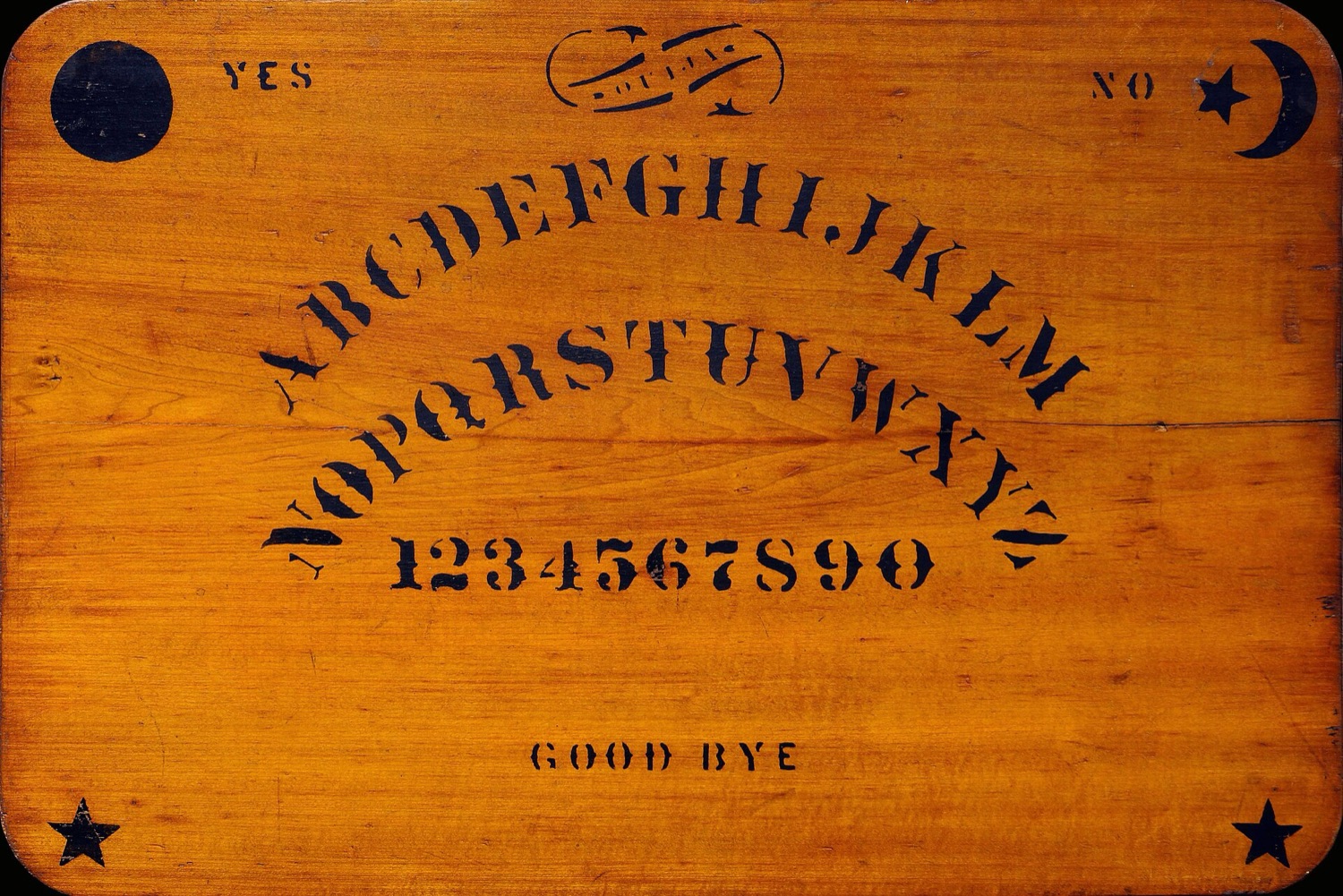
What was lost when the pencil came out was the writing. A pointer gives you letters; a pencil gives you a hand, a speed, a pressure, a signature, a drawing, a line that trails off when the sitter tires. The great case of the Ouija era, Patience Worth, was a writing case: from 1913 the St. Louis housewife Pearl Curran received, through a board and then without it, several novels and thousands of poems in an archaic English she had no way of knowing, and the transcripts fill volumes that scholars still argue over. She had begun on a talking board and moved to dictation because the board was too slow. A pencil planchette would have kept the hand in the record. It is one of the reasons I make them.
VIAn Age Acquainted with Death
It is hard, now, to take the parlour instruments of the nineteenth century as their buyers took them, because a hundred films have taught the modern eye to see a talking board as a door for something to come through. That teaching is recent. Parker Brothers sold the Ouija board as a game for seven years before The Exorcist, in 1973, made it the prop of possession, and from that film forward the board belonged to horror. Before it, the board belonged to grief.
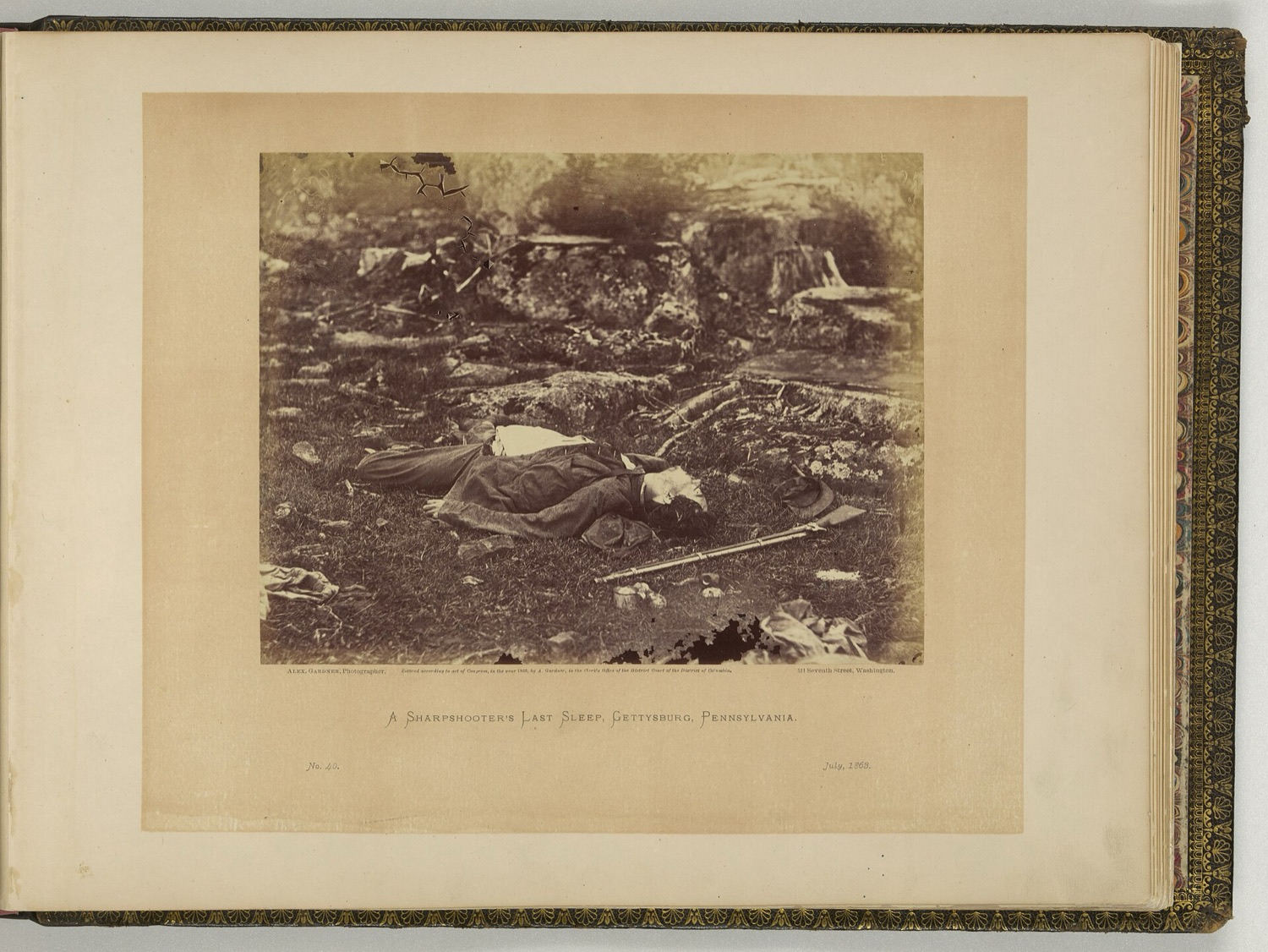
Consider what death was in the years the planchette and the talking board were invented. In the United States of 1870 a newborn had roughly one chance in five of dying before its fifth birthday, and a mother buried a child as a matter of course rather than of catastrophe. Life expectancy at birth was under forty. Tuberculosis, diphtheria, cholera, and childbed took the young; there were no antibiotics, no anaesthetics worth the name until mid-century, and no understanding of infection until after it. And then the war: between 1861 and 1865 something between 620,000 and 750,000 Americans died, more than in all the country’s other wars together, and half of them were never identified. Families received a letter, or nothing. There was no body, no grave, and no answer.
Into that country came a board that answered. It is not surprising that it sold several hundred thousand copies in a season, or that the buyers were not, by and large, thrill-seekers. They were the bereaved, and they were serious, and the movement that grew around the instrument was a religion of consolation before it was anything else. Queen Victoria wore black for forty years for Albert; Mary Todd Lincoln held séances in the White House for Willie; every town had its circle and its medium, and the planchette on the parlour table was not a game but a telephone that might, one night, ring. Read the instruments in that light and their seriousness comes back. They were made to be used with knowledge and with caution, by people who had every reason to want them to work and every reason to fear that they did. I make mine in the same spirit.
VIIThe Spiritualist Church: Its Makers and Its Book
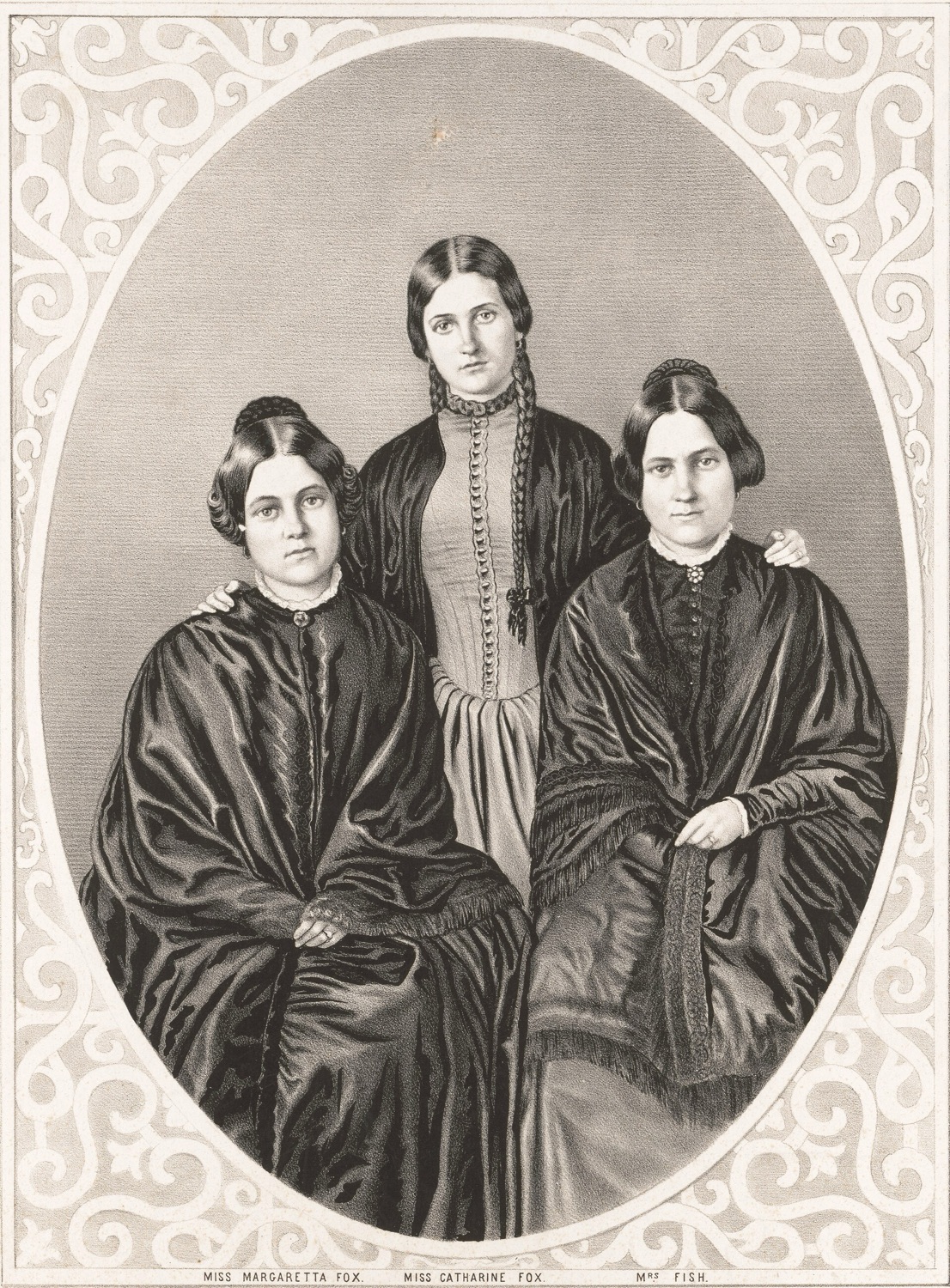
Modern spiritualism dates itself, with unusual precision, from the night of 31 March 1848, when two girls in a farmhouse in Hydesville, New York, Margaretta and Catharine Fox, got answers by rapping from something in the walls. Their elder sister Leah managed them; Rochester, then New York, then the country made them famous; and within five years there were circles in every state and in London and Paris. Forty years later Margaretta confessed the raps were made by cracking her toe-joints, and a year after that recanted the confession, and it made no difference to anyone. The movement had long since stopped depending on the Foxes.
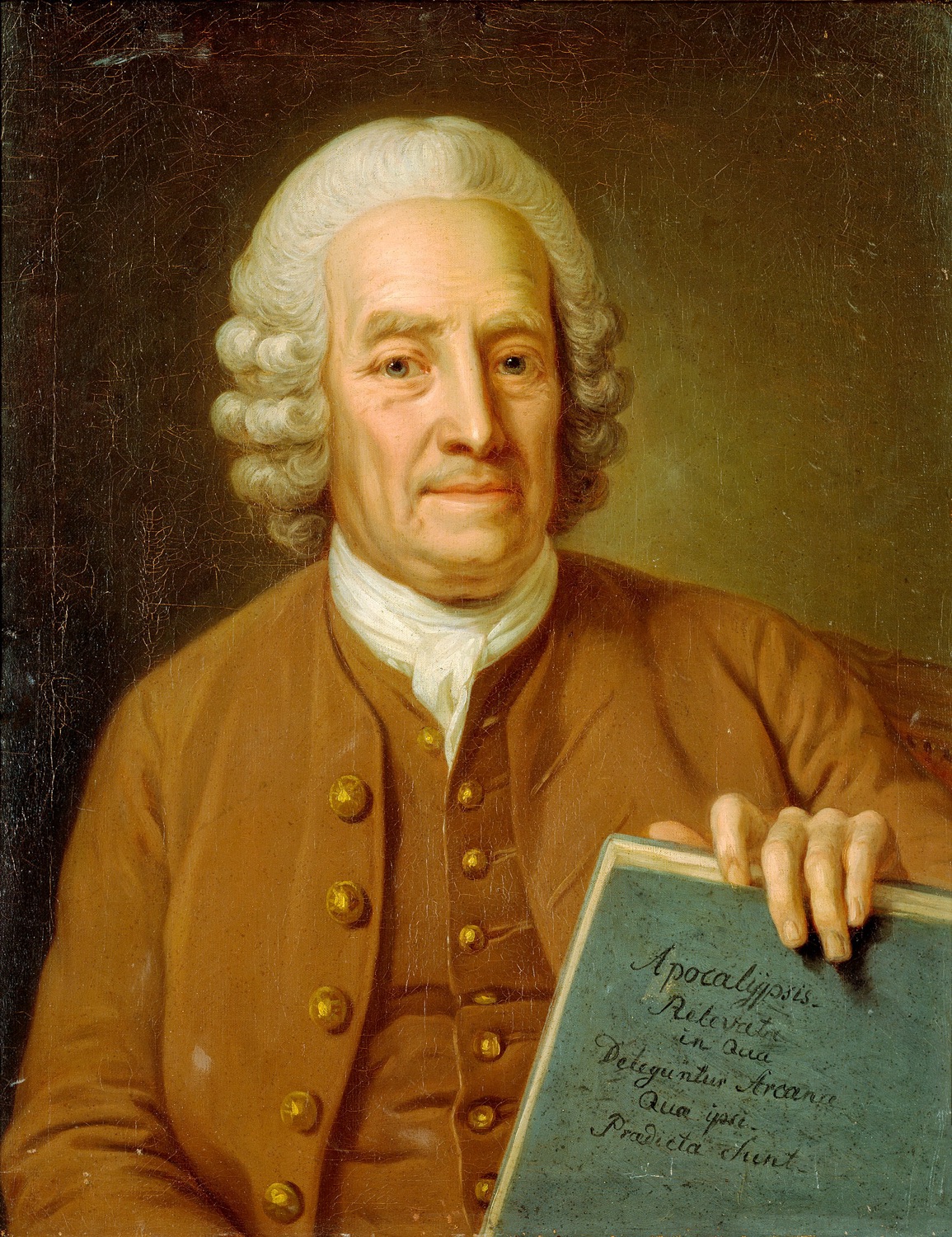
It had, by then, a philosophy, and the philosophy came first. Emanuel Swedenborg, the Swedish engineer and assessor of mines who from 1745 recorded his conversations with angels and the dead in twenty volumes of theology, gave the movement its picture of the afterlife: a world of spheres, in which the dead go on learning and can be spoken to. Franz Anton Mesmer’s animal magnetism, and the trance states his followers found they could induce, gave it a technique. Andrew Jackson Davis, the Poughkeepsie Seer, a cobbler’s apprentice who dictated The Principles of Nature in trance in 1847, welded the two into an American system a year before the Foxes and predicted, in print, that the spirits were about to make contact. When they did, he had the doctrine ready.
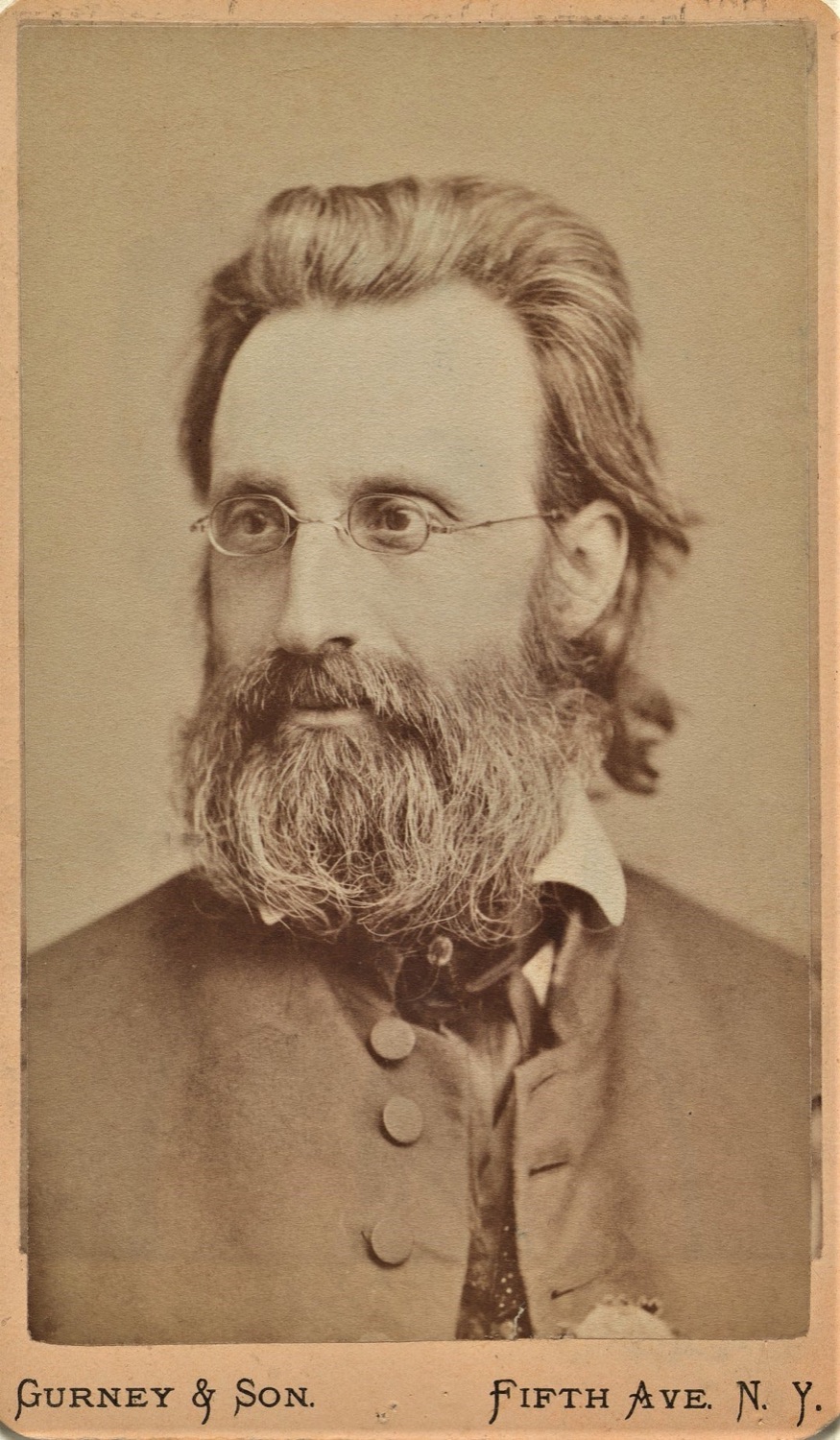
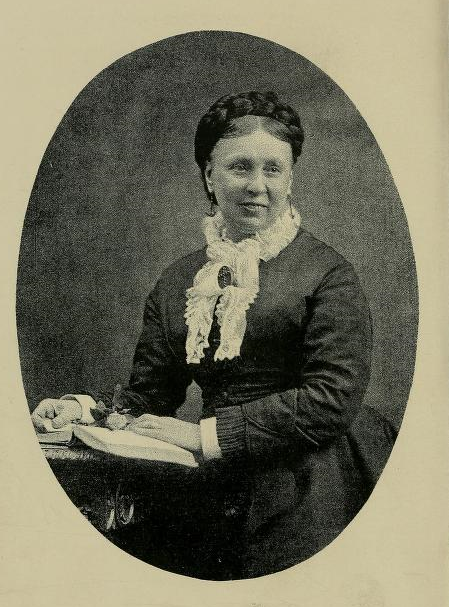
The rest is a roll of names any spiritualist knows. Allan Kardec in France, who made the séance a science and reincarnation an article of faith, and whose spiritism is today a religion of millions in Brazil. Emma Hardinge Britten, the English actress and medium who organised the movement in three countries and whose Seven Principles of 1871, given to her, she said, by the spirit of Robert Owen, are still read at the opening of every Spiritualists’ National Union service. Robert Dale Owen, Owen’s son, whose planchette is on this page. Sir William Crookes, discoverer of thallium, who tested the medium D. D. Home with his instruments and published that the force was real. Sir Oliver Lodge, the physicist, whose Raymond of 1916, on communications from his son killed at Ypres, carried a generation of the bereaved of the Great War. Sir Arthur Conan Doyle, who gave the last twelve years of his life and most of his fortune to the cause and wrote its history. The National Spiritualist Association of Churches was founded in Chicago in 1893; the British Union in 1890; the camps at Lily Dale and Chesterfield, still open, in 1879 and 1886. It is a church with a founding date, a creed, a hymnal, and a ministry, and it was built around a table and a board.
The church has always had to answer one question before any other, and it is the question every purchaser of a planchette has been asked by someone: does the Bible not forbid this? It does, and it does not, and the argument is worth setting out because it is the argument between a spiritualist and a Catholic, and both are my customers.
Against. Deuteronomy 18:10–12 is the text the Church cites, and it is unambiguous: there shall not be found among you one that useth divination, or a charmer, or a consulter with familiar spirits, or a wizard, or a necromancer; for all that do these things are an abomination unto the Lord. Leviticus 19:31 and 20:6 forbid regarding them that have familiar spirits; Isaiah 8:19 asks why the living should seek unto the dead; 1 Chronicles 10:13 says Saul died for asking counsel of one that had a familiar spirit. The Catechism of the Catholic Church (2116–2117) draws the line from those texts to every form of divination, spiritism named among them, as a wish for power over time and other human beings that contradicts the honour due to God alone.
For. The spiritualist answers that the same Saul, in 1 Samuel 28, went to the woman of Endor and did in fact speak with the dead Samuel, who prophesied truly; that on the mountain of the Transfiguration, Moses and Elijah, both long dead, appeared and talked with Jesus before three witnesses (Matthew 17); that Paul lists among the gifts of the Spirit the discerning of spirits (1 Corinthians 12:10) and John commands believers to test the spirits, whether they are of God (1 John 4:1), which presupposes that there are spirits to test; that I am compassed about with so great a cloud of witnesses (Hebrews 12:1); and that the whole of the Christian faith rests on a man who died and afterward spoke with his friends. The Old Testament prohibition, on this reading, is against sorcery for gain and against the false mediums of Canaan, not against the fact of communication, which the Bible records from Genesis to Revelation.
I take no side in print. I say what both sides say: that this is not a toy, that the people who used it in its first century were burying their children, and that anyone who picks up a planchette should do so with knowledge, with care, and with a clear idea of what they are asking and of whom. The instrument does not care. The sitter should.
VIIIFive, and the Proportion of the Board
Every planchette I have made for twenty-three years, in wood, glass, or stone, is cut to the same proportion: one wide, φ high. φ, phi, the golden ratio, is 1.6180339887…, the number you get when you divide a line so that the whole is to the larger part as the larger is to the smaller, and it is the only number that is one more than its own reciprocal. I did not choose it because it is pretty. I chose it because it is the proportion of the pentagon, and the pentagon is the figure of five, and five is the number that runs through the living world at every scale I can look at, from the double helix to the spiral arm. The section that follows is a tour of that in thirteen figures, thirteen being itself a number of the sequence, and it is long because the claim deserves to be shown rather than asserted.
The pentagon
Draw a regular pentagon and its diagonals. Every diagonal is φ times every side, and the star inside makes a smaller pentagon, and that one a smaller star, for ever. Five is the first number that contains φ, and the only one of the regular figures that does.
The golden rectangle
A rectangle whose sides are 1 and φ has a property no other has: cut a square from it and the piece that remains is the same shape. The quarter-circles through the squares make the golden spiral.
The planchette, derived
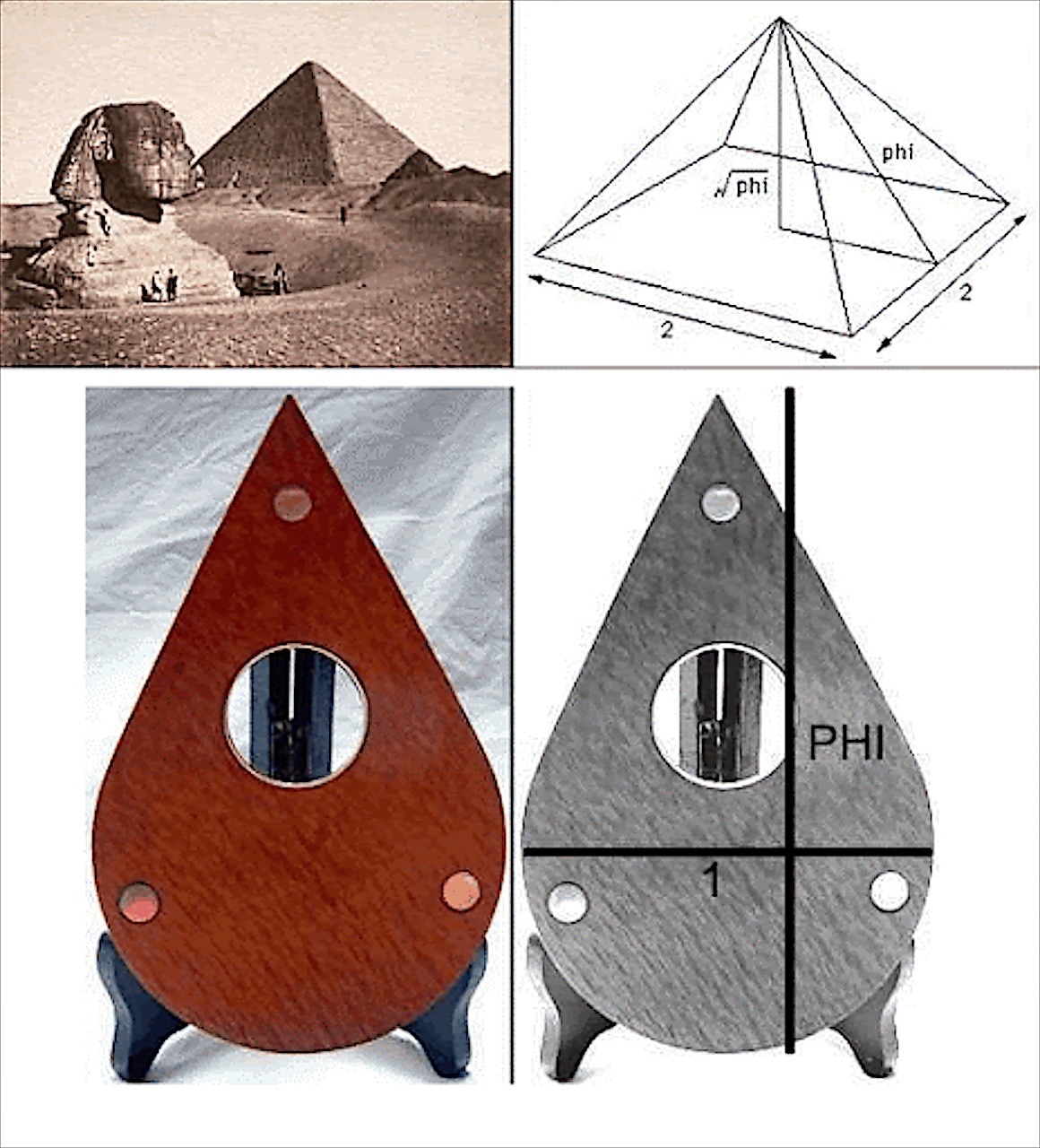
My board is not drawn by eye. A circle of diameter 1; a point at height φ above its base; two tangents. The pencil goes through near the point and two ball castors stand wide at the back, so the board rides on three points, and one of them writes. Nothing on it is arbitrary.
The sunflower
Each new seed at the head’s centre is placed 137.508° round from the last, the golden angle, 360° ÷ φ². It is the one angle that never lets a seed line up with an earlier one, so the head fills evenly; count the spirals and you get 34 and 55, or 55 and 89.
Five, alive
Cut an apple across and the seed chambers make a five-pointed star; the apple, the pear, the rose, the strawberry, the cherry, and the almond all flower in fives, and the starfish and the sand dollar are built on five arms. Five-fold symmetry is rare in the mineral world and common in the living one, and the planchette’s pentagon is on the living side.
The pine cone
The same rule, coarser: 8 spirals one way, 13 the other. Pineapples run 8, 13, 21. The rule is not aesthetic; it is what packing does when every new part is laid at the golden angle.
The double helix
One full turn of B-DNA is 34 ångströms long and 21 ångströms across. Both are Fibonacci numbers, and their ratio is 1.619. This is the measurement from Watson and Crick’s own 1953 model, and it is the φ in every cell.
The hand
Measure the bones of a finger from the tip inward and each is close to φ times the one before, out to the metacarpal in the palm. Close, not exact: bone is grown, not drawn. The proportion is why the hand reads as beautiful and why a planchette cut to φ sits in it without thought.
The pyramid
A right triangle with sides 1, √φ, φ is the only one whose sides make a geometric progression; Kepler wrote of it in 1597. The Great Pyramid’s half-base is 220 cubits and its height 280: a ratio of 1.2727, against √φ = 1.2720. Whether Khufu’s architects meant φ or merely a slope of 5½ palms to the cubit, the stone says φ within a twentieth of a per cent.
The spiral in the sky
Hurricanes, spiral galaxies, the nautilus, the ram’s horn, and the path of a hawk all follow the logarithmic spiral, r = a·e^(bθ), a curve that stays the same shape as it grows. The golden spiral is the member of that family whose radius grows by φ each quarter turn. Not every galaxy is golden. Every one is logarithmic, and that is the deeper fact.
The forbidden crystal
Crystals were not allowed five-fold symmetry until 1982, when Dan Shechtman saw a ten-fold diffraction pattern in an aluminium-manganese alloy and was told he was wrong for two years. The rings in the pattern are spaced by φ. He got the Nobel Prize in 2011, and the pentagon got back into solid matter.
Two honest notes, because a proportion is only worth building on if you know where it holds. Some of what is said about φ is measurement: the golden angle in the sunflower, the Fibonacci spirals of the cone, the 34 and 21 ångströms of DNA, the diagonal of the pentagon, and the quasicrystal are facts you can check with a ruler, a microscope, or a diffractometer. Some is approximation: the finger bones, the pyramid, the nautilus, which follows a logarithmic spiral but not the golden one. And some is a family resemblance: the hurricane and the galaxy are logarithmic spirals, of which the golden spiral is one member. What is common to all of it is the pentagon’s number, and the reason it recurs is not mystical but structural. φ is the most irrational of numbers, the one hardest to approximate by fractions, and so it is the ratio that growth chooses when it needs to add parts for ever without ever letting them fall into line. A sunflower is solving a packing problem. A pentagon is the shape its solution makes. I cut the board to it so that the hand rests on a figure that the body already knows.
The Fibonacci sequence
Leonardo of Pisa’s rabbits, 1202: 1, 1, 2, 3, 5, 8, 13, 21, 34, 55, 89… Each is the sum of the two before, and the ratio of neighbours closes on φ from both sides. These are the numbers that count the spirals in a cone, the seeds in a head, and the ångströms in a turn of DNA.
The heart, from the formula
Kirby’s planchette of 1868 was a heart, and hearts are the other shape I make. Mine are not drawn freehand. There are two curves that give a heart exactly: the cardioid, the path of a point on a circle rolling round another of the same size, whose equation in polar form is r = 1 − sin θ, and the parametric heart, a sum of four cosines that closes into the familiar figure with its two lobes and its point. I plot the curve at the size of the board, transfer it to the wood, and cut to the line. A heart made from a formula is a heart that is the same every time and that the eye reads as right without knowing why; the same reason I cut the teardrop to φ.
Two hearts with equations
Left, the cardioid, r = 1 − sin θ, the curve you see in the bottom of a coffee cup when the light is right. Right, the parametric heart, plotted from four terms. Either is transferred to the board at full size and cut.
IXThe Antiques, the Cheap, and Mine
Antique planchettes have become collectible in the last thirty years, and rightly. A Kirby or a Cottrell of 1868, a Fuld pointer of 1920, a French board of the Second Empire with its castors of bone and its pencil-holder of brass: these are beautiful things and they carry their history in their wear. They are also, nearly all of them, thin, light, roughly made, and badly balanced, because they were novelties made by the thousand for a season’s trade. The castors are small and the rubber has perished; the pencil is held by friction and rides up; the board is a single thin plank that has cupped; the glass ones chip at the edges. Their makers were not trying to make a fine instrument. They were trying to meet a fad, and they did.
The modern trade is worse. The planchettes sold with talking boards today are stamped plastic, or laser-cut fibreboard with a plastic window, weighing nothing, riding on three plastic nubs, and moving under the fingers like a bar of soap on a wet floor: which is to say, they move whether anything is pushing them or not, and tell you nothing. I have handled hundreds. I have not handled one I would put on my own table. I am, as far as I can find, the only makers anywhere who cut the board to a proportion, cast my own brass, fit a pencil clamp that holds, and finish the instrument as a cabinet-maker finishes a cabinet.
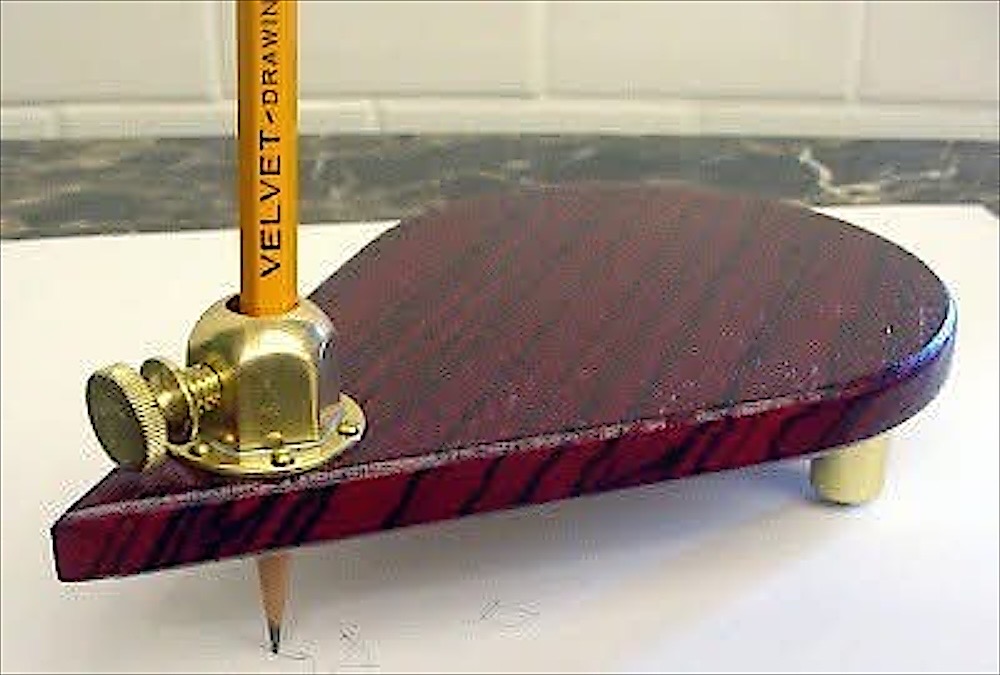
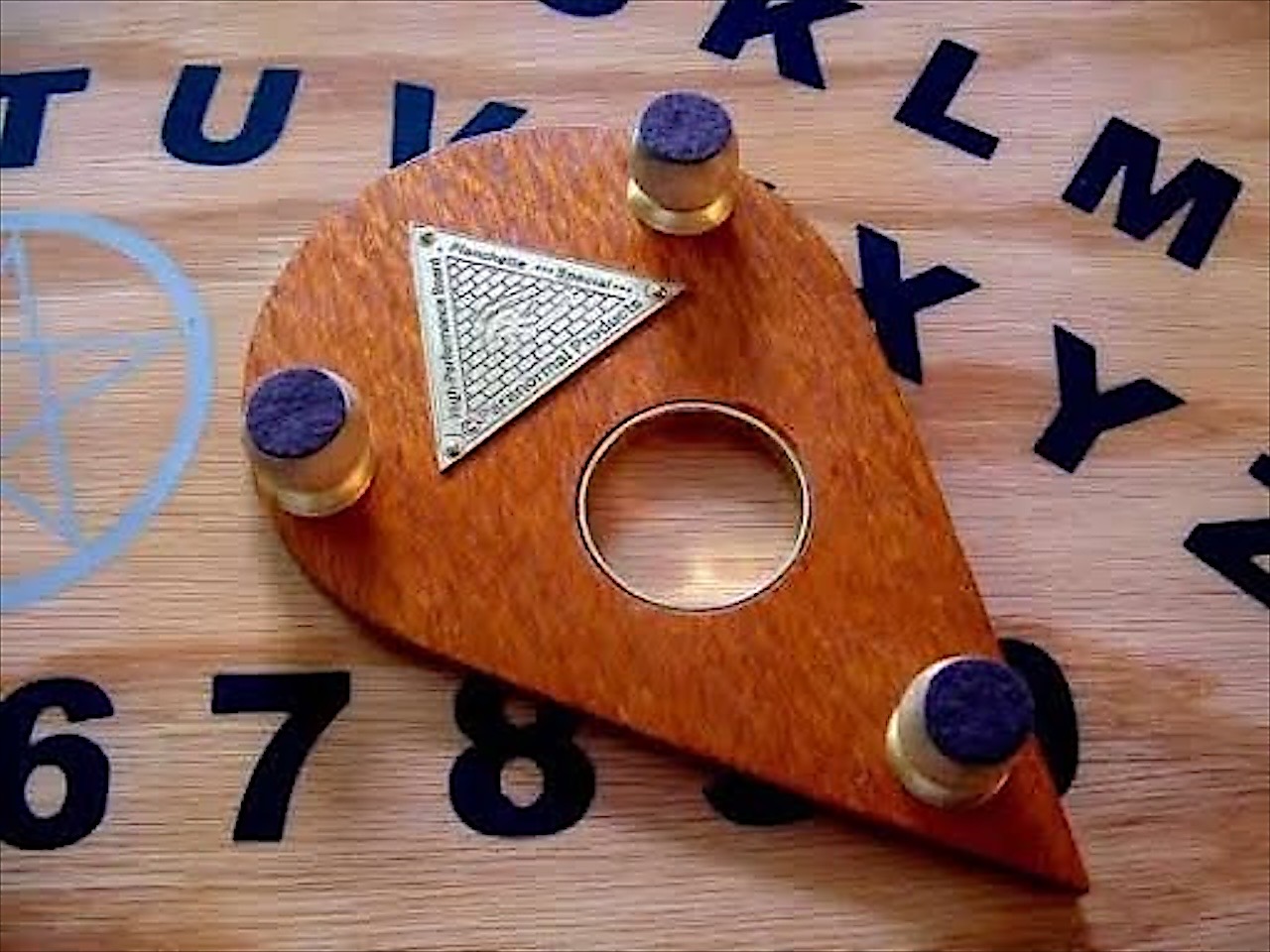
Here is what I do differently, and why. Weight and balance. A planchette must be light enough to move under resting fingers and heavy enough not to move under nothing; the margin is narrow and it is set by the wood, the thickness, and the brass. Mine are made to sit still on a level board and to start with the first tremor. Castors. On the writer, two, set wide at the back where my pointer carries its own, with the pencil as the third point, so the board rides on the line it draws. Each stands about an inch tall: a gold-plated half-inch tube whose rolled rim grips a polished stainless-steel ball a shade smaller than itself, so that less than half the ball shows, on a pierced washer of five lobes and five screws with fans of arcs between them. The pointer’s feet go under felt. The pencil holder. A rounded square block on a round flange ringed with rivets, its knurled thumbscrew facing the point, so the pencil is set once, to touch the paper by a hair, and stays set; the pencil never rides, the line never breaks. On its top end the pencil carries a half-inch weight of gold-plated brass that gives the point a little more downforce, which is unique to mine. The pencils are unfinished cedar, and every planchette comes with a selection of them, enough for long use; pencils coated in dragon’s blood are available too. Under the point it comes out through a small plate in the same φ teardrop, engraved with rings and a star, and in the middle of the underside is my etched plate of the pyramid and the Eye of Horus. The metal. Every fitting and logo plate gold plated and polished to a mirror, the screws and pins stainless; the special editions in pure solid silver or 24-karat gold. The lens. A turned ring, gold plated, that frames the letter beneath it exactly, so that a reading is a reading and not an estimate. The wood. Bloodwood, walnut, East Indian rosewood, and others, quarter-sawn where the figure allows, finished under enough coats to read as glass. Glass and stone. The glass model after 1868, so the sitters watch the writing; the stone models, in granite, marble, and serpentine, which are the heaviest and the quietest pointers there are. Proportion. Every one to φ. The case. Lacquered, hinged, lined, and cut to the instrument, because it will be kept.
Fumed oak: time, hurried
Oak darkens on its own. Its heartwood is full of tannins, the same astringent compounds that once tanned leather in oak-bark pits, and over the decades, in light and air, they slowly oxidise and carry the wood from pale honey to the deep brown of an old church pew. Nothing is added. The colour was in the tree all along, waiting.
Fuming hurries it. The oak is shut in an airtight chamber with a dish of strong ammonia, and the vapour reacts with those same tannins, so that in days the wood takes the colour that time would have given it in a lifetime. Because the change is in the wood rather than on it, the colour sinks below the surface, the grain stays clear instead of being clouded as a stain would cloud it, and it does not fade. White oak, richest in tannin, goes the deepest brown; its sapwood, which has little, stays pale; red oak can turn faintly green. Even boards from one tree take it a little differently, which is why no two fumed pieces are exactly alike. It is not a thing to try in a kitchen: the ammonia is many times stronger than the household kind.
Every workshop tells the same story of how it was found: in English stables, where oak stored near the horses turned brown in the ammonia of their urine. Gustav Stickley told it in 1909, and how many centuries it reaches back nobody can say. What is written down is that a correspondent to a journal in 1894 said he had been fuming oak for thirty years, and that Stickley brought the method to America in 1901, where it coloured the Arts and Crafts furniture of a generation, his own and Limbert's and the Roycrofters'.
That is the oak I use: a wood that has been given its age honestly, by its own chemistry.
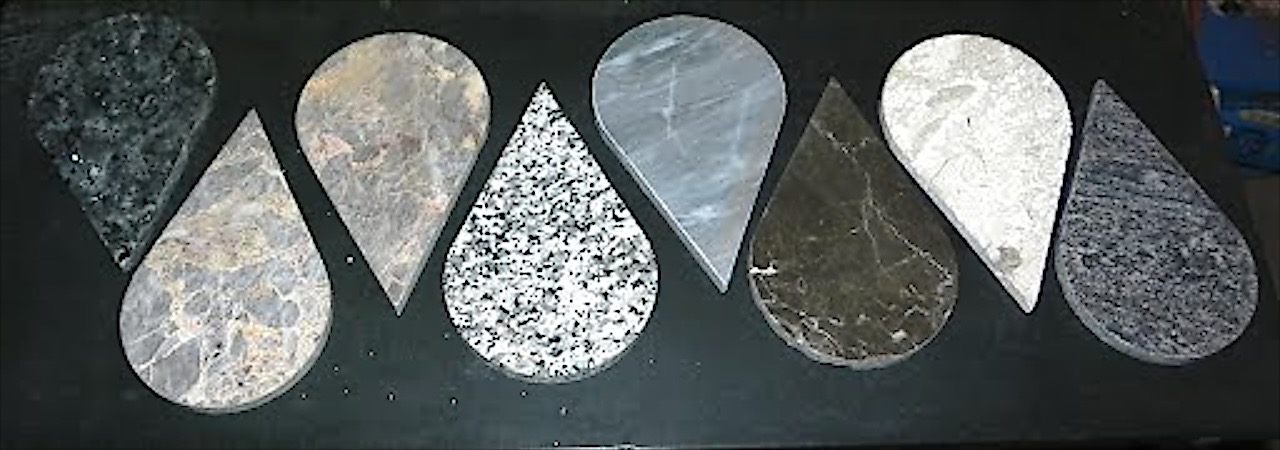
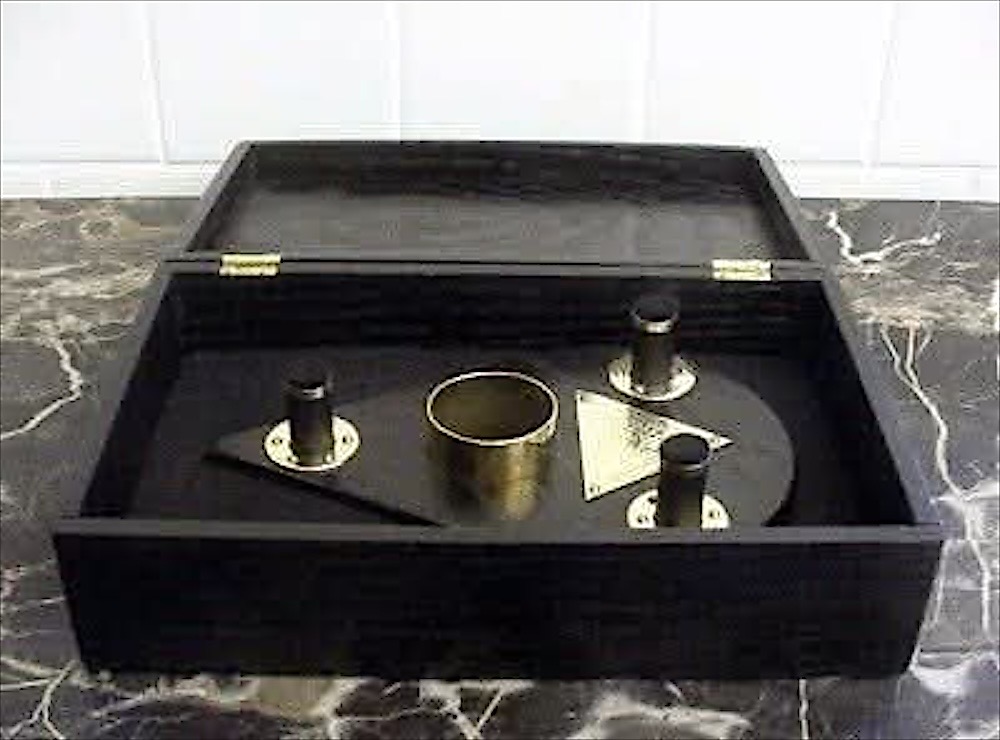
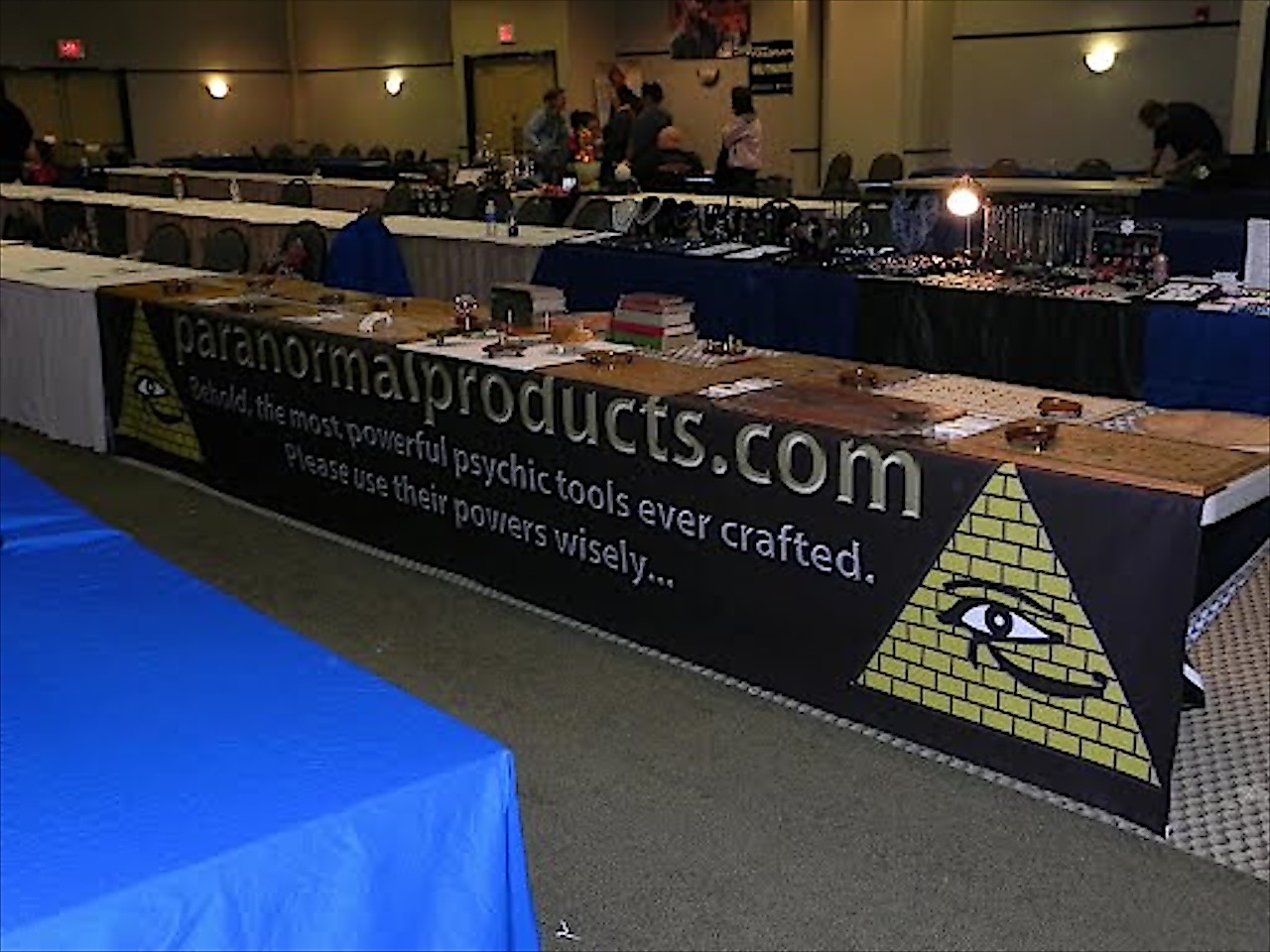
My planchettes have been on the table in the films Paranormal Activity and Paranormal Activity 2, on television, and on stage; they have been carried to conventions on three continents, and they sit in the collections of people who own the Kirbys and the Fulds and reach for mine when they want the board to work. I have sold them under the name Paranormal Products since 2003 and I make every one, still, by hand.
XMethod
For writing: a smooth table, a large sheet of plain paper, a soft pencil, and two sitters, or one who is patient. Set the pencil so that it just touches. Rest the fingertips on the board, lightly, the elbows free, and do not push and do not hold back. Talk, if you like; the Victorians did. Wait. Kirby’s label said a few moments for some and twenty minutes for others, and that is still true. When it moves, let it. The first sessions give strokes and circles, as Kardec said they would; letters come later, words later still. Keep every sheet, dated, in the book that comes with the instrument, because the book is the only way you will ever know what the board does over a year, and because the pages are the point.
For pointing: the board level, the planchette at the centre, the fingers on its edges, one question at a time, spoken aloud. Read at the lens, not by eye. Write the answers down as they come. Say good-bye when you finish; the board has a place for it, and the custom is older than the board.
In either case: keep the wood out of the sun and the glass out of the dishwasher, wipe the gold with a soft dry cloth and never use metal polish on it, which takes the plating off, and do not lend it. The calibration of a planchette is the hands that use it.
And the part that books on this subject leave out, because it is the part where the sales stop. This is an instrument for adults, and I do not knowingly sell it to a child. Do not use it if you are unwell in the mind; do not use it alone, or drunk, or at three in the morning; and do not use it every day. The practice works by loosening the seam between what you intend and what your hands do, and that is an absorbing discipline for most people and a genuine danger for a few. Do not take orders from it: a session that has begun telling you whom to cut off, what to pay or where to go has stopped being a session, and that is a clinical line rather than a supernatural one. If a sitting frightens you, close it with the word the board keeps for the purpose, do something ordinary, and sleep. Nobody needs clearing afterwards, and anyone offering to sell you clearing is selling you the second half of a fear they sold you the first half of. All of this is argued at length, with the case-book and the science, at The Channel, which is the companion to this page and covers what the instrument is for.